WEEE authorized representative in Germany: who needs one

11 min read
WEEE authorized representative in Germany: when makers outside the EU need one under § 8 ElektroG, what the mandate covers and what EU plans would change.
You make electrical or electronic devices outside the EU, from smart plugs to power tools, and want to sell them in Germany. Before your devices reach the German market, a producer must be registered for your brand with the German WEEE register, and a company without an establishment in Germany needs a WEEE authorized representative to do this (§ 6(1), § 8 ElektroG). Here is who needs one, what the mandate must contain and why your EU Authorized Representative for CE marking does not cover it.
What a WEEE authorized representative does
Under extended producer responsibility (EPR) for waste electrical and electronic equipment (WEEE), whoever puts a device on a national market pays for its pick-up, treatment and recycling once it becomes waste. The WEEE Directive 2012/19/EU (opens in a new tab) sets the frame, but every member state keeps its own register of producers (Article 16); in Germany the rules are in the Electrical and Electronic Equipment Act (ElektroG) (opens in a new tab).
The ElektroG covers electrical and electronic equipment up to 1,000 volts AC or 1,500 volts DC, including equipment for business customers, with a few exclusions such as large fixed installations and means of transport (§ 2, § 3 No. 1).
A WEEE authorized representative is a company established in Germany that a producer without a German establishment has commissioned to carry out all producer obligations under the ElektroG in its own name (§ 3 No. 10 ElektroG (opens in a new tab)). The authority registers the representative with the details of the producer it represents and issues a registration number for each producer (§ 37(1)).
Who needs a WEEE authorized representative in Germany, and who does not
The ElektroG names four kinds of producer (§ 3 No. 9): (a) brand owners who make or have made devices and offer them in Germany, (b) companies selling other makers' devices under their own brand, (c) whoever first offers devices from abroad on the German market, and (d) distance sellers abroad supplying end users in Germany. Without an establishment in Germany, producers under (a) to (c) must appoint a representative (§ 8(1) ElektroG (opens in a new tab)), and so must distance sellers (§ 8(2)).
| How you sell into Germany | Producer under § 3 No. 9 ElektroG | Representative needed by you? |
|---|---|---|
| Own online shop or marketplace account, shipping to end users in Germany | You, as a distance seller (d) | Yes, § 8(2) |
| You offer your brand in Germany yourself, for example to retailers, without an establishment there | You, as the brand owner (a) | Yes, § 8(1) |
| Your only buyer is an importer that buys from you abroad and first offers the devices in Germany | The importer (c) | Not if you sell only to this importer and it registers as producer; agree this in writing |
| Your subsidiary in Germany imports and sells | The subsidiary (c) | Not for these sales; if you also sell directly, you need one, and the subsidiary can take the role |
A guarantee is required for every device that can be used in private households (§ 7(1)), and waste from devices that both households and businesses could use counts as household waste (§ 3 No. 5). Selling only to businesses is not enough: a take-back concept replaces the guarantee only if you make credible that a device is used exclusively or usually outside households (§ 7(3), § 7a).
The mandate: written, in German, one representative
The mandate must be in writing and in German and run for at least three months, and each producer may appoint only one representative for all of its brands and device types (§ 8(1) ElektroG). stiftung ear, which handles WEEE registration in Germany, also expects both parties to sign (stiftung ear guide for companies abroad (opens in a new tab)).
You name the representative to the authority without delay, with a copy of the mandate, and the appointment requires the authority's confirmation (§ 8(3)); in practice, the representative handles these steps in its stiftung ear account. A representative that already holds 20 registrations needs the authority's approval for further ones (§ 8(3), § 37(7) ElektroG (opens in a new tab)).
When the mandate ends, you report this to the authority and, once it confirms the end, inform the importers and retailers you supply; the representative stays responsible for obligations that arose during its appointment (§ 8(4)). Plan the handover early, because the authority can then revoke the registration (§ 37(5) No. 2).
Who handles what after registration
The representative acts in its own name but depends on your data; your contract should mirror this split:
| Duty | ElektroG | Handled by |
|---|---|---|
| Registration per brand and device type before the first sale | § 6(1), § 37(1) | Representative, in its own name |
| Insolvency-proof guarantee each calendar year for devices usable in households | § 7(1), (2) | Representative |
| Take-back concept for devices made credible as used only or usually outside households | § 7(3), § 7a | Representative, with your take-back options |
| Quantity reports: monthly by the 15th, or yearly by 30 April where no guarantee is needed | § 27(1), (2) | Representative, from your sales data |
| Pick-up of collection containers assigned by the authority | § 16(1) | Representative |
| Registration number in offers and on invoices | § 6(3) | You |
| Producer identification, date marker and crossed-out wheeled bin symbol on the device | § 9 | You |
Five steps before your first sale in Germany
- Check scope and use: list each device, its category and whether households could use it (§ 2, § 7).
- Map your sales routes: settle who is the producer on each route and agree in writing with importers who registers (§ 3 No. 9).
- Sign one mandate: in writing and in German, for at least three months, with a representative established in Germany (§ 8(1)).
- Register before the first offer: the representative registers each brand and device type with a guarantee or take-back concept (§ 6(1), § 7, § 7a).
- Prepare listings, devices and data: registration number in offers and on invoices, marking on each device, sales data for the reports (§ 6(3), § 9, § 27).
Example: a U.S. maker of kitchen appliances
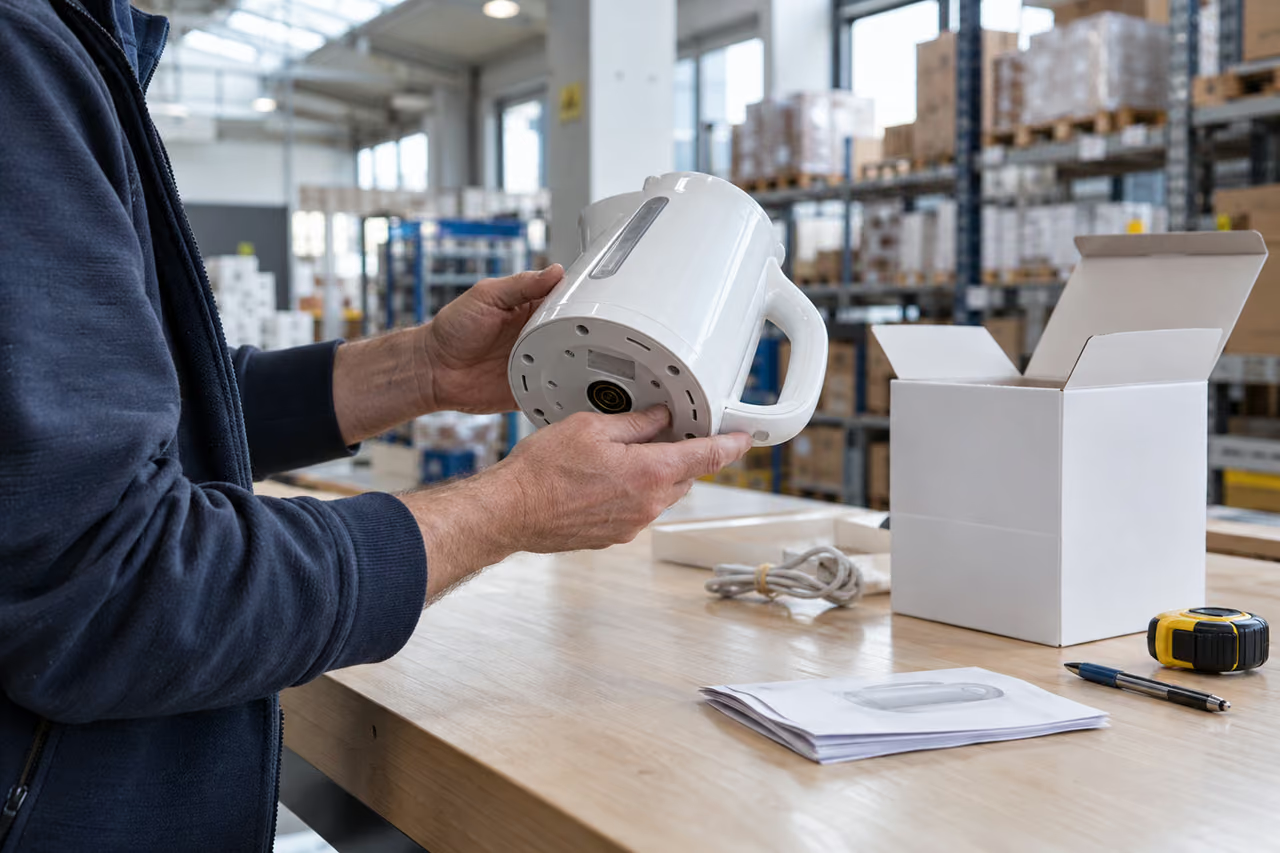
A U.S. company sells kettles and blenders to consumers in Germany through its own online shop, plus a commercial coffee grinder for cafés. As a distance seller, it is the producer for all three products (§ 3 No. 9(d)) and appoints one representative in Germany.
The representative registers the kettles and blenders with a guarantee and reports monthly. For the grinder, the company makes credible that it is usually used in businesses, not households, so a take-back concept replaces the guarantee and its reports are yearly (§ 7(3), § 7a, § 27(2)). The shop shows the registration number in every listing and on every invoice, and each device carries the bin symbol and a date marker.
When a German retail chain wants to stock the kettles, expect it to ask for your registration number: a retailer that intentionally or negligently offers new devices of an unregistered producer is itself deemed a producer (§ 3 No. 9, final clause).
Will the EU drop the representative requirement?
In December 2025, the Commission proposed suspending, until 1 January 2035, the rule that obliges distance sellers established in one member state to appoint a WEEE representative in each other member state they sell to (COM(2025) 983 (opens in a new tab), Article 1(b), on Article 17(2) of Directive 2012/19/EU).
For manufacturers outside the EU, the proposal changes nothing: the rules for producers in third countries "should remain as they currently are contained in sectoral legislation" (explanatory memorandum), because enforcement against them is harder (Recital 6).
On 20 October 2026, Parliament adopted amendments that would limit the suspension of Article 17(2) to micro and small enterprises established in the EU, and referred the file back to its environment committee for negotiations with the Council (text adopted by Parliament (opens in a new tab); procedure file 2025/0396(COD) (opens in a new tab)). Nothing had been adopted into law, and negotiations in the Council had been discontinued (Legislative Train (opens in a new tab)).
An adopted directive also needs national transposition, 12 months under Article 2 of the proposal. Until a change reaches the ElektroG, § 8 applies as written.
Common mistakes with WEEE in Germany
- Adding a brand without registering it. Registration is per brand and device type (§ 6(1)), so each new one needs its own registration before the first sale.
- Leaving the number off listings and invoices. § 6(3) requires it; fines reach 100,000 euros (§ 45(1) No. 5, (2) ElektroG (opens in a new tab)).
- Skipping zero reports. Months without sales still need a report of zero (§ 27(1) ElektroG (opens in a new tab)); fines for missing reports reach 10,000 euros (§ 45(1) No. 15, (2)).
- Forgetting the batteries inside. Built-in batteries need their own EPR registration and, in Germany, a written mandate in German for an EPR representative under battery law (§ 40(2) BattDG (opens in a new tab)); see the Battery Regulation 2027.
- Expecting the marketplace to register for you. The ElektroG obliges it to block offers of unregistered producers (§ 6(2) sentence 2 No. 2), not to register on their behalf.
Conclusion: one mandate in Germany, before the first sale
Without an establishment in Germany, the WEEE authorized representative belongs in your market entry plan: one written mandate in German, confirmed and registered before the first offer. The EU proposal does not change this for manufacturers outside the EU. Other representative roles are compared in this overview.
We support WEEE representation as part of our Representation pillar, and WEEE registration and reporting through Packaging, EPR & Sustainability. For the CE side of the same devices, see EU Authorized Representative and our page on electronics.
Frequently asked questions
Do I need a WEEE authorized representative if I only sell to businesses in Germany?
Yes, if you have no establishment in Germany and the devices are not excluded under § 2(2) ElektroG, for example as large-scale stationary industrial tools. Selling to businesses does not remove the guarantee; a take-back concept replaces it only for devices made credible as used only or usually outside households (§ 7(3), § 7a ElektroG).
Can my EU Authorized Representative act as my WEEE representative in Germany?
Only if it is established in Germany and you give it a written mandate in German for the WEEE role (§ 3 No. 10 and § 8(1) ElektroG). A representative without an establishment in Germany cannot take the German WEEE role.
Can a marketplace or fulfillment service provider be my WEEE authorized representative?
The ElektroG allows it if the company is established in Germany and accepts your written mandate in German for at least three months (§ 3 No. 10, § 8(1) ElektroG). Listing on a marketplace does not make it your representative; without your registration, it must block your offers (§ 6(2) ElektroG).
Will the EU omnibus proposal remove the obligation for manufacturers outside the EU?
No. Proposal COM(2025) 983 would suspend only Article 17(2) of the WEEE Directive, which concerns distance sellers established in one member state selling into another, and keeps the rules for producers in third countries. Parliament's amendments of 20 October 2026 would narrow it to micro and small EU enterprises. As of 20 October 2026, it had not been adopted.
Do I need a WEEE representative in the UK as well?
The UK has its own rules. A supplier outside the UK selling directly to UK users is a producer and must either appoint an authorized representative established in the UK or join a compliance scheme itself (regulations 2D and 14, WEEE Regulations 2013). For household sales via an online marketplace, the operator is the producer.